
This map tracks crime and city service trends over time, for any Chicago location and level of detail you choose.
The timelines trace each indicator back several years, so a recent spike or drop can be read against the longer pattern behind it. Watching several at once shows which tend to rise and fall together, which stay steady, and which reflect rare one-time events.
The timelines also make it easy to spot which indicators move together, which hold steady, and which reflect rare events. Seeing what's actually shifting over time is how the city can tell whether its public safety efforts are working.
Explore More Chicago Crime Maps
Go deeper with each map. Start with the overview for a citywide snapshot, then view the other maps to compare Community Areas or zoom in on individual blocks.
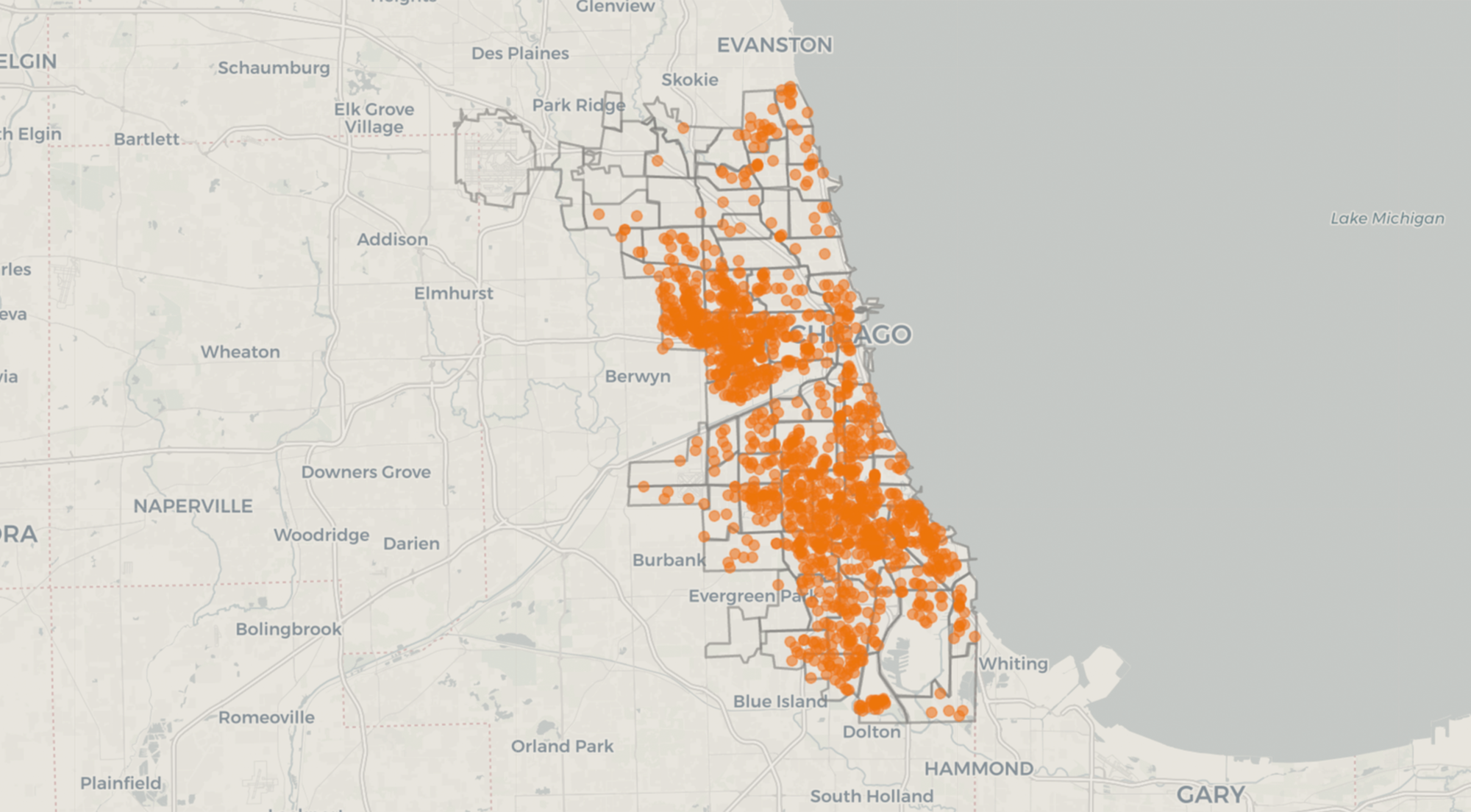
Return to the citywide view of shootings and homicides over the past 12 months.

Compare Community Areas by rate to see where violence is most concentrated and how each area ranks.

Zoom to the block level to spot hot spots and watch how conditions shift street by street.
Mapping Methodology
Crime Definitions
- Shooting Victims: Number of fatal and non-fatal shooting victims.
- Homicide Victims: Number of homicide victims. Includes murder, negligent, and non-negligent manslaughter. Justifiable homicide is not included.
- Violent Crime Incidents: Number of incidents. Includes robbery, rape/criminal sexual assault, aggravated assault/battery, and homicide.
- Assault Offenses: Number of assault offenses. Assault is defined as engaging in conduct which places another in reasonable apprehension of receiving bodily harm.
- Battery Offenses: Number of battery offenses. Battery is defined as intentionally causing bodily harm to someone, and should include all non-fatal shootings if classified correctly.
- Burglary Offenses: Number of burglary offenses. Burglary is defined as the unlawful entry of a home or other building to commit a felony or theft.
- Motor Vehicle Theft Offenses: Number of motor vehicle theft offenses. Motor vehicle theft is defined as the theft or attempted theft of a motor vehicle.
- Robbery Offenses: Number of robbery offenses. Robbery is defined as the taking or attempting to take anything of value from the care, custody, or control of a person by force or threat of force.
- Theft Offenses: Number of theft offenses. Theft is defined as the unlawful taking, carrying, leading, or riding away of property.
311 Definitions
- Abandoned Vehicle Complaints: Count of reports of abandoned vehicles.
- Building Violations: Count of reported general building code violations.
- Clean Vacant Lot Requests: Count of requests to clean vacant lots.
- Street Light Out Complaints: Count of complaints of a light out in a street, alley, or viaduct or complaints of damage to street light poles.
- Graffiti Removal Requests: Count of requests for graffiti removal.
- Liquor Establishment Complaints: Count of complaints for liquor license violations.
- Shared Housing/Vacation Rental Complaints: Count of complaints about shared or vacation housing rentals.
- Vacant/Abandoned Buildings Complaints: Count of reported vacant/abandoned buildings.
- Vicious Animal Complaints: Count of reported animals exhibiting signs of aggressiveness.
Census Data Definitions
- Block: Census geographic unit representing an area bounded by visible features such as streets, roads, railroad tracks, and streams. Residences facing each other across a street are on different blocks. Blocks can vary substantially in population.
- Block Groups: Census geographical unit representing an area with around 1,500 residents.
- Unemployment Rate: The percentage of the labor force that is unemployed. The labor force includes people aged 16 or older who are either employed or actively seeking employment.
- Public Assistance Income or SNAP Usage Rate: The percentage of households who used public assistance income or food stamps/SNAP benefits last year.
- No High School Graduation Rate: The percentage of the population who did not graduate high school or obtain a GED.
- Moved in the Last Year Rate: The percent of the population who moved within the last year.
- Poverty Rate: The percentage of people whose total family income in the past 12 months falls below the official poverty threshold. The income level of the threshold varies depending on the size of the household and the age of its members.
Other Definitions
- Ward: A geographic district in Chicago used for local governance. Each ward elects an alderman to represent residents and serve on the City Council.
- Hot Spots: Hot spots are identified by aggregating incident data at the census block level over a specified time period, then selecting only those blocks that fall in the top 5% (95th percentile) of total incidents. Blocks meeting or exceeding this threshold are designated as hot spots, with a minimum threshold of at least 2 incidents to avoid treating single-indecent blocks as hot spots.
Sources
- Chicago Police Department through the Chicago Data Portal API
- Chicago Service Requests through the Chicago Data Portal API
- Chicago demographic data from the U.S. Census Bureau 2019-2024 American Community Survey 5-year estimates
Limitations
The data presented here comprise the best available information published by the relevant public agencies. Like all large datasets, they are imperfect. Crime classifications are provided by the reporting agencies and may change later based on additional investigation. Many agencies do not guarantee the accuracy, completeness, timeliness, or correct sequencing of their information.
This site provides applications using data that has been modified for use from its original source, www.cityofchicago.org, the official website of the City of Chicago. The City of Chicago makes no claims as to the content, accuracy, timeliness, or completeness of any of the data provided at this site. The data provided at this site is subject to change at any time. It is understood that the data provided at this site is being used at one’s own risk.
Visualization Notes
- Data are totaled at the time period of your choosing (e.g., 30 days, 90 days, 1 year) from the ending date selected.
- The shading represents the concentration of the selected crime type or service request where darker colors represent higher volume.
- Trend lines are scaled based on the maximum value for the outcome in the specified timeframe. Therefore, the absolute value of the trend lines are not comparable but the relative change can be compared across outcomes.
Additional Notes
- Offense definitions come from the National Incident-Based Reporting System (NIBRS) and are based on common-law definitions.
- Crime and service request data are updated monthly.
For questions about data and methodology, please email chipublicsafety@norc.org.